Stellar
A Riemann sum is an approximation of the area under a curve found by dividing an interval into subintervals and using rectangles to estimate the area. The width of each rectangle is usually written as Δ x, and the height comes from the function value at a chosen point in each subinterval. If the function is above the x-axis, this approximates area; more generally, it approximates signed area. The idea is that many thin rectangles usually give a better approximation than a few wide ones. This is one of the main bridges from geometry to integration.
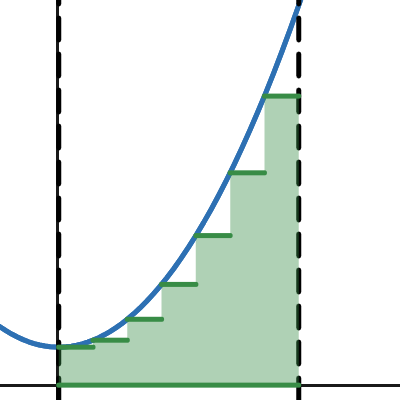
There are different types of Riemann sums depending on how the rectangle heights are chosen. A left Riemann sum uses left endpoints, a right Riemann sum uses right endpoints, and a midpoint Riemann sum uses midpoints. For an increasing function, left sums tend to underestimate and right sums tend to overestimate. For a decreasing function, the opposite happens. You should be comfortable building these sums from tables, graphs, or formulas and understanding that they are approximations to a limit-based quantity that will later become the definite integral.
An example of a LEFT riemann sum is below: