 Stellar
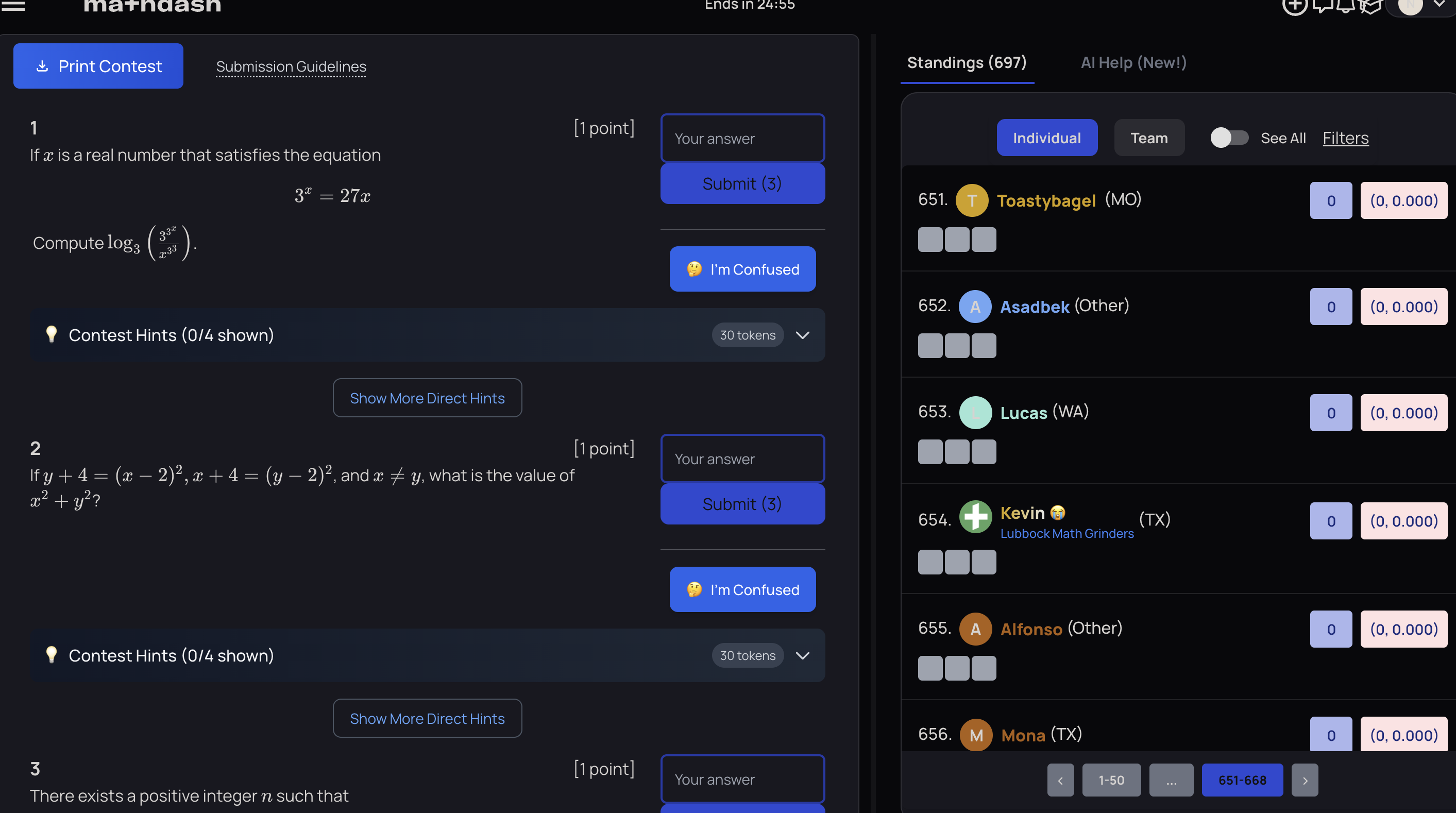
When students begin preparing for AMC, AIME, MATHCOUNTS, and other competitive math contests, MathDash is often one of the first specialized platforms they encounter. And to its credit, MathDash has built a strong product in the competition math space. Its platform offers a gamified training environment, rating-based progression, AI coaching, thousands of practice problems, and support for contests like AMC 8/10/12, AIME, and MATHCOUNTS.
For many students, MathDash is a solid introduction to structured competition math prep. However, as students become more serious about maximizing scores and developing true olympiad-level problem-solving ability, many begin looking for a platform that offers more than just gamified drilling. That is where Stellar Learning differentiates itself.
MathDash Is a Strong Drill Platform. Stellar Is a More Complete Competitive Math Ecosystem.
MathDash’s greatest strength is its gamified practice engine.
Its rating systems, live arenas, adaptive difficulty, and fast-paced training environment make practice engaging and help students build consistency through repetition.
But gamified drilling is only one part of high-level competition math preparation.
As students move toward stronger AMC/AIME performance, success depends increasingly on:
- Deep conceptual understanding
- Structured topic mastery
- Exposure to varied problem-solving frameworks
- Careful solution analysis
- Learning why methods work, not just pattern recognition
Stellar is built to support that broader development process.
Rather than focusing primarily on drill mechanics, Stellar provides a more complete competition math workflow combining instruction, guided learning, rigorous practice, analytics, and mastery progression.
Stellar Emphasizes Learning and Strategy, Not Just Repetition
One limitation of many gamified competitive math platforms is that students can sometimes improve rating/performance through familiarity and repetition without fully internalizing deeper strategies.
That is not enough for top-tier AMC/AIME performance.
Competitive math success requires students to understand:
- Why certain approaches work
- How to recognize hidden structures
- When to pivot strategies mid-problem
- How to generalize techniques across topics
Stellar’s competitive math system is designed around that philosophy.
Students do not simply grind problems. They learn:
- Core concepts interactively
- Problem-solving frameworks explicitly
- Strategic heuristics for contest math
- Common traps and misleading patterns
- How to break down novel unseen problems
This produces stronger long-term mathematical development than repetition alone.
Stellar Is Built for Students, by Students
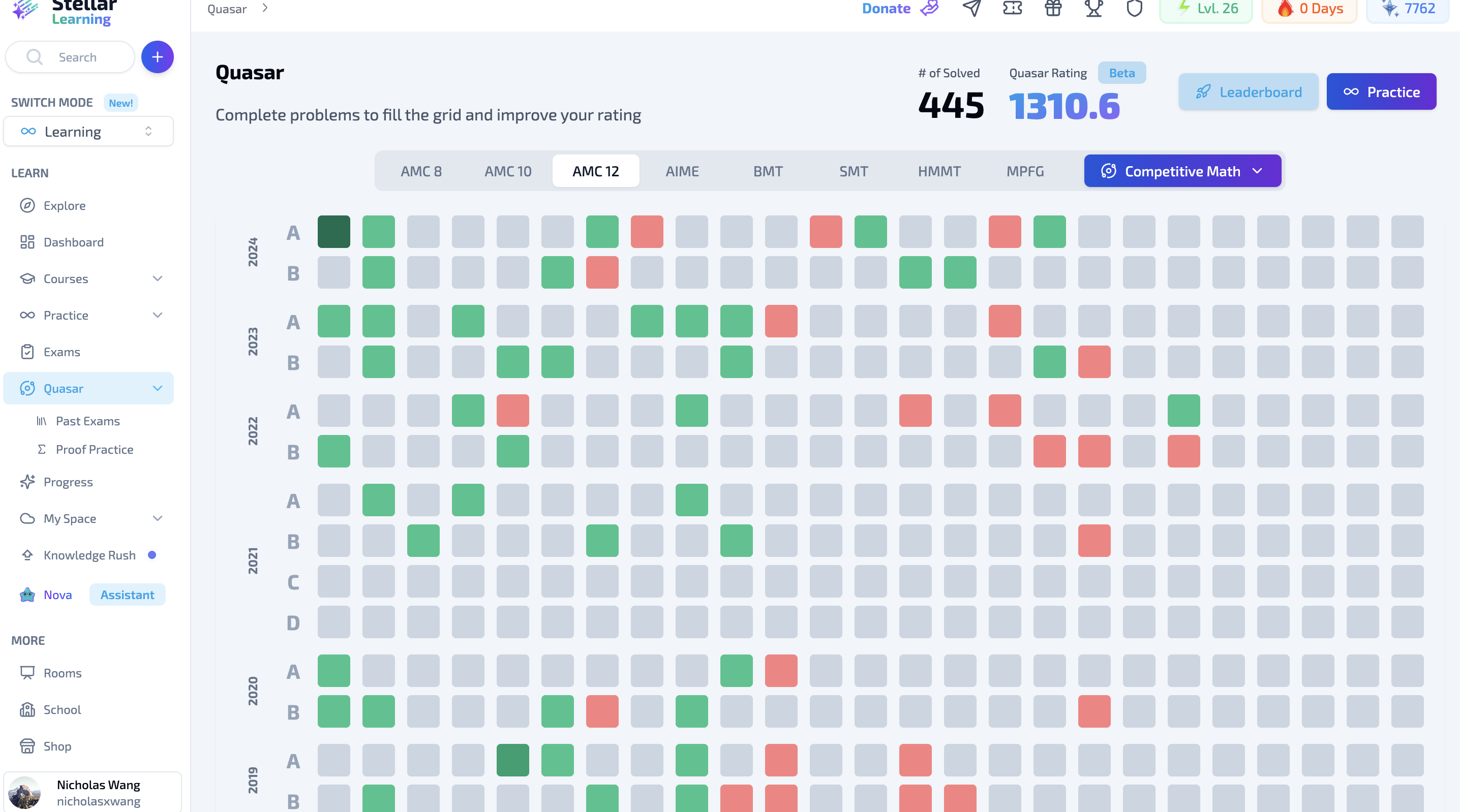
One of Stellar’s biggest advantages is that its competition math content is designed by students who have actually succeeded in advanced math environments.
As with its AP curriculum, Stellar’s academic systems are developed by high-achieving student contributors with firsthand experience in rigorous academic and competitive settings.
Because Stellar is built for students by students, its content is informed by people who understand:
- Where students plateau in contest prep
- Which topics create the biggest jumps in score
- What separates average AMC students from AIME qualifiers
- How students actually learn advanced problem-solving most effectively
Stellar Prioritizes Quality and Depth Over Pure Quantity
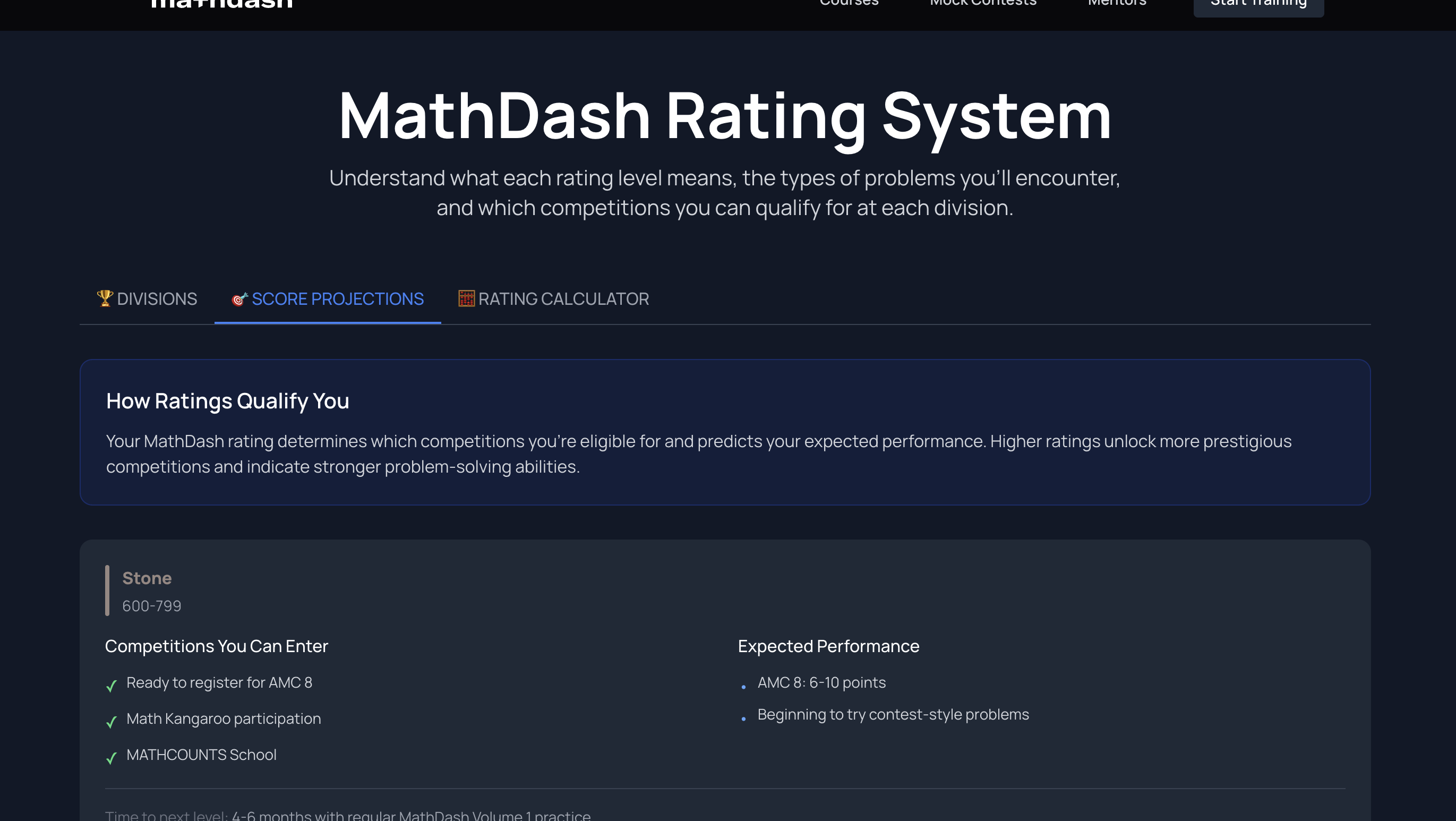
MathDash advertises large problem libraries and thousands of practice questions.
While quantity matters, problem count alone does not determine prep quality.
The strongest competition math prep comes from:
- High-quality problem selection
- Thoughtful sequencing by difficulty
- Strong explanations and walkthroughs
- Topic scaffolding
- Strategic progression design
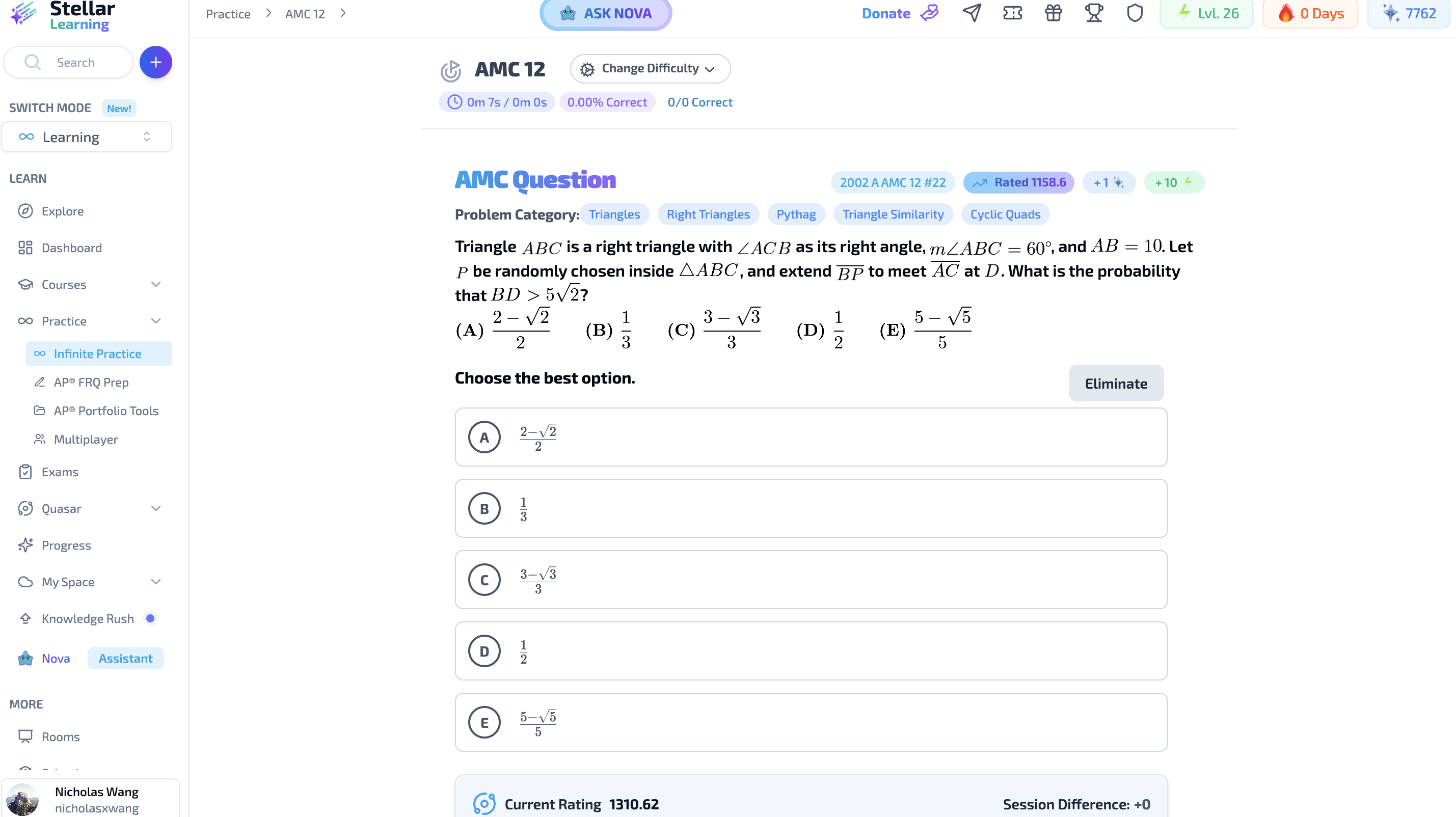
Stellar focuses heavily on curation, instructional value, and structured progression rather than simply maximizing raw volume.
The goal is not to give students more problems. The goal is to give them the right problems in the right sequence with the right instruction.
Stellar Provides Broader Academic Value Beyond Competition Math
Another major advantage of Stellar is platform breadth.
MathDash is specialized almost exclusively around competition math and gamified contest prep.
Stellar allows students to build competitive math skills while also supporting broader academic goals through integrated:
- AP preparation
- SAT/PSAT prep
- IB coursework
- Honors-level academics
- Additional enrichment pathways
For ambitious students balancing school and competitions, this makes Stellar a far more versatile long-term platform.
Final Verdict: MathDash vs. Stellar Learning
MathDash is a strong and well-designed competitive math drill platform. Its gamification, adaptive ratings, and contest-style training make it an excellent tool for students who want engaging daily practice.
But for students seeking the most complete and rigorous path toward high-level competitive math performance, Stellar Learning offers a broader and more educationally robust platform.
Stellar provides:
- Stronger conceptual instruction
- Better strategy-focused problem-solving development
- More structured mastery progression
- Higher emphasis on explanation and understanding
- Broader academic ecosystem integration
- A platform built for students, by students
Bottom line: MathDash helps students practice competition math. Stellar helps students master it.