Stellar
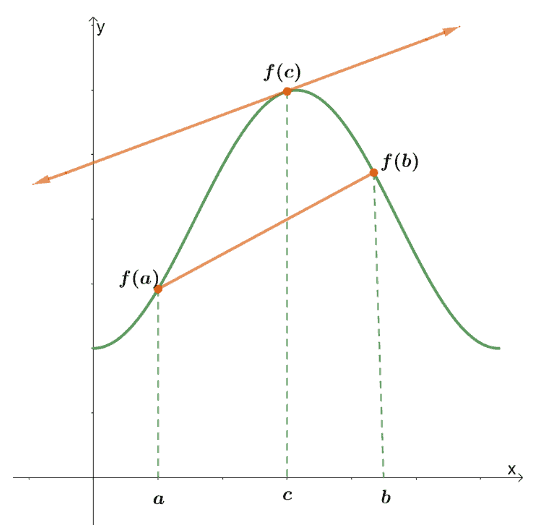
The Mean Value Theorem states that if a function f is continuous on the closed interval [a,b] and differentiable on the open interval (a,b), then there exists at least one value c in (a,b) such that . In words, this means that at some point in the interval, the instantaneous rate of change must equal the average rate of change over the whole interval. Geometrically, there is at least one tangent line parallel to the secant line connecting the endpoints. This theorem is important because it connects overall change on an interval to local behavior at a specific point, which is a major theme of calculus.