Stellar
Particulate diagrams
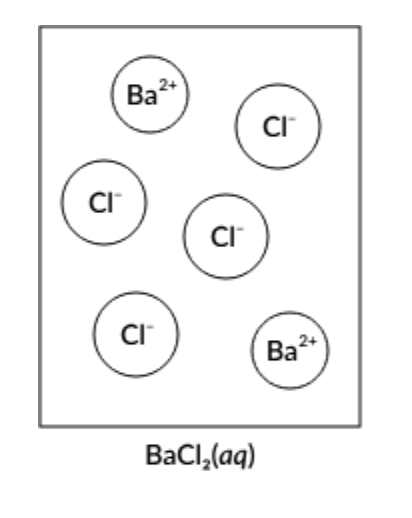
Particulate diagrams are useful in showing what actually happens in a solution. In a solution, there may be different concentrations of different ions. In this case, the AP Exam may ask you to draw a particle diagram. In these diagrams, you don’t have to show every single particle (there are at least 1020 particles so good luck anyways) but you will have to show the relative concentrations. Also, these solutions are usually dissolved in water, so you will not have to show the water particles in the diagram since they are implied to be everywhere.
What you will be required to do is show the relative concentration of the ions. For example, if 1 mole is dissolved in 10 liters of water, this means that there will be 2 moles of ions and 1 mole of ions in the 10 liters of water. Doing the calculations, we get that there will be 0.2 M of and 0.1 M of . So when you draw this, you should have twice the amount of ions than you do for ions.