Stellar
Phase Changes
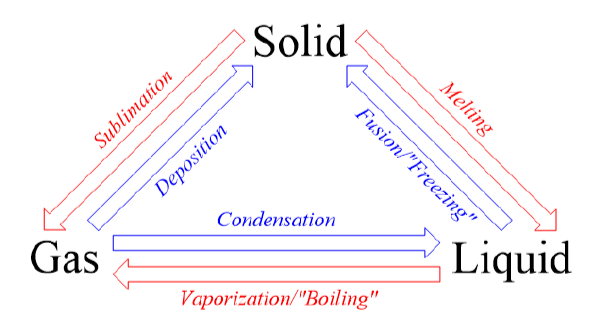
In order to go into a more disordered state, like from liquid to gas, energy must be input to break the IMFs in the liquid phase, turning the particles into a gas. This usually requires much more energy than increases or decreases in temperature, in which we use heats of vaporization and heats of melting. For example, water requires 40.7 kJ/mol to turn from a liquid to a gas, which is known as its heat of vaporization. Note that since condensation is simply the opposite of vaporization, the heat of condensation will simply be -40.7 kJ/mol. This also applies to a body’s heat of melting and heat of fusion.