Stellar
Enthalpies of Formation
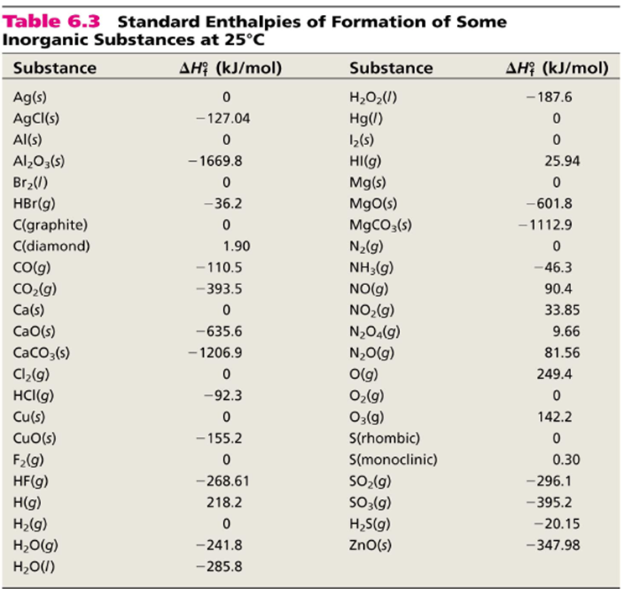
Another way to find the enthalpy of a reaction is through using the enthalpy of formation. An enthalpy of formation is the energy change when one mole of a compound forms. Unlike bond enthalpies which are always positive, enthalpies of formation can be positive, negative, or zero. An enthalpy of formation being negative usually means that the compound is more stable that the atoms that make it up. For example, the enthalpy of formation of liquid water is negative since it is more stable than pure hydrogen and oxygen. The opposite is true for positive enthalpies of formation. A zero enthalpy of formation means that the compound can be found naturally, such as H2 gas or O2 gas. The table below shows common values for enthalpies of formation at standard conditions.